 For many Amazon sellers, advertising feels like a necessary evil.
You spend on ads just to get visibility.
You increase bids just to stay competitive.
And at the end of the month, it feels like Amazon took most of your profit anyway.
If you’ve ever thought “I’m spending more on ads than I’m making in sales” or “PPC feels like pay-to-play with no payoff”, you’re not alone. These frustrations show up again and again among new and low-revenue Amazon sellers
This is exactly why TACoS — Total Advertising Cost of Sales — matters more in 2026 than ever before.
In this guide, we’ll break down:
- What TACoS really tells you (and why ACoS alone is misleading)
- Why most sellers fail to reduce TACoS
- How to build a repeatable TACoS reduction system using retail media data
- Real-world examples of what actually works
- A practical framework you can apply even with a small budget
This is not about cutting ads blindly.
It’s about turning ads into a growth engine instead of a profit leak.
What Is TACoS — and Why It Matters More Than ACoS in 2026
TACoS (Total Advertising Cost of Sales) measures how much you spend on advertising relative to total revenue (ad + organic).
Formula:
TACoS = Total Ad Spend ÷ Total Revenue
This is fundamentally different from ACoS, which only looks at ad-attributed sales.
Why does that matter?
Because many sellers have:
- “Good” ACoS
- But terrible profitability
A campaign can look efficient on paper while doing nothing to build organic momentum.
TACoS answers the real question Amazon sellers should be asking:
“Are my ads helping my business grow — or am I just buying sales?”
Why TACoS Is the Metric Amazon Sellers Ignore (Until It’s Too Late)
New sellers often:
- Launch a product
- Turn on ads
- Hope sales follow
But what actually happens is:
- Ads become the only source of sales
- Organic rank never improves
- Every dollar earned goes back into PPC
This exact frustration shows up repeatedly among struggling sellers: “All my revenue goes straight back into ads”
TACoS exposes that problem immediately.
If your TACoS stays flat or rises over time, it means:
- Organic sales are not growing
- Ads are not compounding
- You’re stuck renting traffic instead of building equity
In 2026, with higher CPCs and tighter margins, this is not sustainable.
The Core Problem: Most Sellers Treat Ads as a Shortcut, Not a System
Here’s the hard truth:
Most Amazon sellers don’t have a TACoS problem.
They have a system problem.
Based on real seller feedback, common patterns include:
- Spending aggressively on PPC hoping for traction
- Cutting prices when ads don’t convert
- Begging for reviews through every allowed method
- Following Amazon’s training but still feeling blindsided
- None of these fix the underlying issue:
Ads are not connected to organic growth.
A 2026 TACoS Reduction System does the opposite:
- Ads are used intentionally
- Organic rank is the goal
- Data drives every decision
Let’s break that system down.
The 2026 TACoS Reduction System (High-Level Framework)
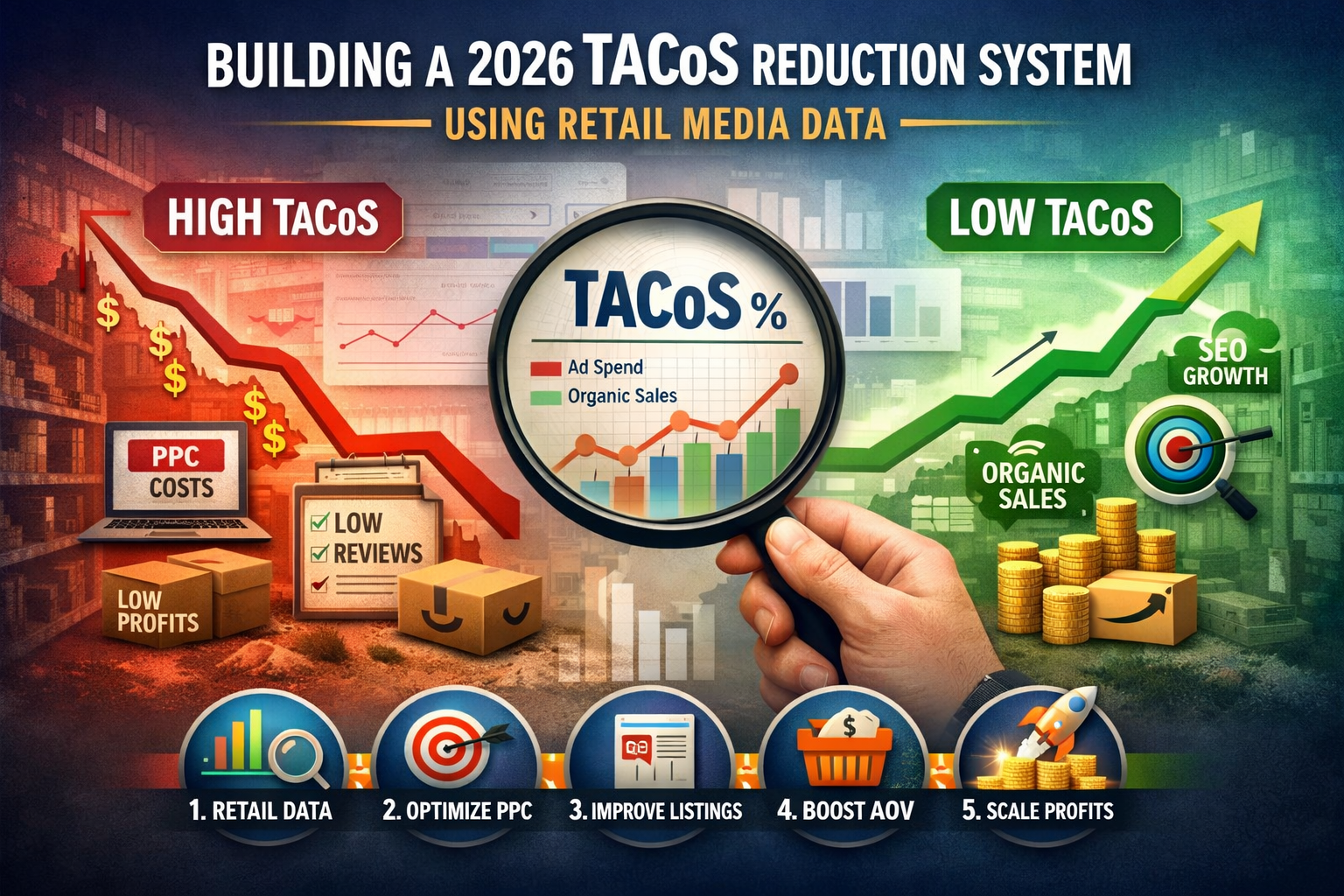
At Sellers Catalyst, we look at TACoS reduction as a flywheel, not a switch.
The Flywheel:
- Retail Media Data Collection
- PPC Efficiency Optimization
- Organic Conversion & Rank Improvements
- Revenue Expansion (AOV + Repeat Sales)
- Continuous Feedback & Iteration
Each layer compounds the next.
If even one layer is weak, TACoS stalls.
Step 1: Use Retail Media Data the Right Way (Not Just for Reporting)
Most sellers download reports and never act on them.
That’s wasted opportunity.
In 2026, retail media data should answer three questions:
- Where am I wasting money?
- Where am I buying profitable visibility?
- Which ads actually improve organic performance?
The Minimum Data You Must Track
- Total ad spend (weekly + monthly)
- Total revenue (not just ad revenue)
- TACoS trend over time
- Search term–level performance
- Conversion rate by ASIN
The goal is not perfection — it’s trend clarity.
If TACoS is rising month over month, something is broken.
Step 2: Fix PPC Efficiency Before Cutting Spend
Many sellers try to reduce TACoS by turning ads off.
That’s usually a mistake.
The real fix is waste removal, not visibility loss.
PPC Moves That Lower TACoS Without Killing Sales
1. Ruthless Search Term Cleanup
- Pause terms with spend but no conversions
- Add negative keywords aggressively
- Separate research campaigns from performance campaigns
2. Shift Budget to “Rank Builders”
Not all keywords are equal.
Some keywords:
- Drive profitable sales
- Improve organic rank
- Lower TACoS over time
Others only generate ad-dependent sales.
Retail media data helps you identify which is which.
3. Embrace Long-Tail, Low-Competition Keywords
High-volume keywords are expensive.
Long-tail keywords are strategic.
They:
- Convert better
- Cost less
- Signal stronger buying intent
This is where many new sellers can actually win.
Step 3: Organic Conversion Is the Hidden TACoS Lever
You cannot reduce TACoS if your listing doesn’t convert.
And yet, sellers often:
- Spend on ads
- Ignore listing quality
- Blame traffic
From real seller feedback, many tried keyword tools and ads but still saw “very little organic traction”
That’s not a traffic problem.
That’s a conversion problem.
Fix These Before Scaling Ads:
- Clear value proposition in the title
- Benefit-driven bullet points
- Visual clarity in images
- Trust signals (reviews, A+ content)
When conversion improves:
- Ads become cheaper
- Organic rank improves
- TACoS naturally drops
Step 4: Increase Revenue Per Click (The Fastest TACoS Win)
Here’s a tactical insight many sellers miss:
You don’t always need more sales.
You need more revenue per order.
Ways to Do That:
- Bundles
- Multipacks
- Subscribe & Save
- Price anchoring
If a $1 click leads to:
- A $25 order → 4% ad cost
- A $50 order → 2% ad cost
Same click.
Lower TACoS.
This is especially powerful for sellers struggling with Amazon fees and thin margins — a pain point mentioned repeatedly by low-revenue sellers
Step 5: Use Ads to Build Organic Rank (Not Just Sales)
This is where most sellers fail.
They run ads for immediate sales, not long-term rank.
A TACoS-focused strategy asks:
- Which keywords should I rank for organically?
- Which campaigns support that goal?
Ads that improve organic rank:
- Pay off even after spend stops
- Reduce long-term dependence on PPC
- Create compounding returns
This is how strong brands escape the “PPC hamster wheel.”
Real-World Example: From PPC Dependency to Sustainable Growth
One publicly documented Amazon brand entered with:
- High ad spend
- Flat organic rank
- TACoS above 15%
Instead of cutting ads, they:
- Removed wasteful keywords
- Focused spend on rank-driving terms
- Improved listing conversion
- Increased AOV with bundles
Result:
- TACoS dropped into single digits
- Organic sales replaced paid sales
- Profitability improved dramatically
The key wasn’t less advertising — it was smarter advertising.
Why Most Sellers Never Escape High TACoS
Based on real seller experiences, the biggest blockers are:
- Expecting ads to “fix” everything
- Reacting emotionally instead of strategically
- Not connecting PPC to organic goals
- Chasing short-term sales over long-term equity
And yet, the dreams remain:
- Quitting the 9-to-5
- Hitting $100K+ in annual revenue
- Building real financial freedom
Amazon Sellers Hopes and Challe…
Reducing TACoS is one of the most reliable paths toward those goals — because it’s about keeping more of what you earn, not just selling more.
Final Thoughts: TACoS Is a Growth Metric, Not a Cost Metric
In 2026, successful Amazon sellers will not be the ones who:
- Spend the most on ads
- Chase the highest impressions
- Panic over CPC increases
They’ll be the ones who:
- Use retail media data intelligently
- Treat ads as a growth lever
- Build systems that compound over time
TACoS is not about cutting back.
It’s about building forward.
If your ads are not increasing organic sales, improving rank, or raising lifetime value, they’re not doing their job.
And that’s where a real TACoS reduction system changes everything.
Want Help Building Your TACoS Reduction System?
At Sellers Catalyst, we help Amazon sellers:
- Diagnose TACoS leaks
- Rebuild PPC for sustainable growth
- Turn ad spend into organic momentum
If you’re tired of “pay-to-play” advertising and want a system that actually scales, it may be time to rethink how you use retail media data.